



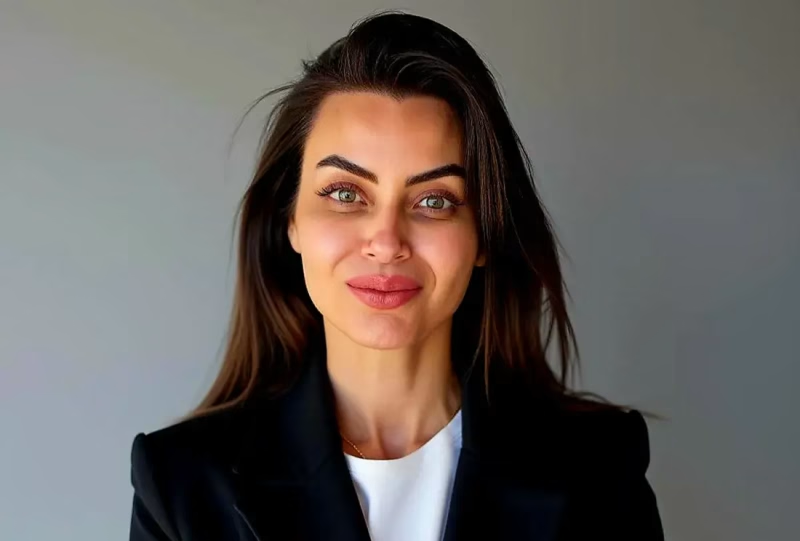
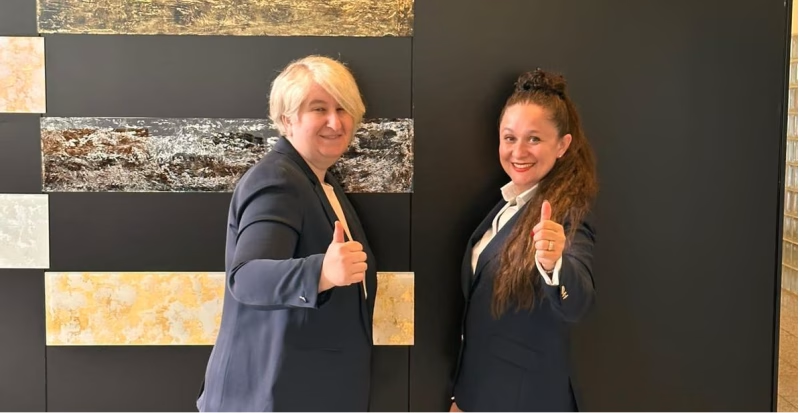





In this insightful interview, we explore the entrepreneurial story of a Romanian-born entrepreneur speaking from Switzerland who managed to osmose tech, art and old world mystique into her very own business philosophy. And her label, Disruptive Humans, carries a bold mission: to inspire transformation before it is necessary. With a background in corporate IT and extensive personal development, Antonia fused her two passions – innovation and Chinese Metaphysics – into a unique approach to self-innovation and strategic execution for her clients. A strong advocate for the capabilities of generative AI, she can expand the boundaries of technology with the assistance of rapidly advancing technologies, while also utilizing empathy with a human-focused design approach. With corporate workshops, social innovation projects and her own personal empowerment tools she is not only reshaping the way we innovate in business, but also how we innovate ourselves first.
Can you describe your entrepreneurial journey and the motivation behind starting your business?
I am Romanian at heart, living in Switzerland now, but my entrepreneurial journey began in Romania, and it was most of the times in parallel with my corporate jobs. I’ve done a lot of different things, but two of them stand out. I was so passionate about Innovation that I was asked in 2021 to deliver some workshops on Creative Problem Solving, the Culture of Innovation and Leadership Styles. So, I started doing this type of practical workshop type of work under my own brand – Disruptive Humans. The philosophy behind Disruptive Humans is: “Innovate Today – Change before you’re forced to.” Now, I am looking to inspire my clients beyond how to innovate at work, in their business and organizations, but also how to redesign the way they look at change and innovation for themselves.
Now, for the second thing. I’ve been learning, practicing and teaching Feng Shui for over 20 years now, because I started when I was very young. By popular demand, this year I am trying out something new and combining my 2 big passions for Innovation and Feng Shui. I’ve launched new workshops, where clients can learn how to use the 5 elements of Chinese Metaphysics to Innovate themselves. Think of it like this: An ancient system of understanding human energy and transformation, used by emperors and healers for thousands of years — now applied to your personal growth. Just like nature flows through fire, earth, metal, water, wood — and so do you. Each element reflects a part of your mindset, emotions, energy, and purpose.
How do you stay ahead of technological advancements in your industry, and how has this impacted your business model?
Having worked in the corporate world of IT, Software Development and Telecommunications, I have a deep passion for Technology. I am an early adopter of new technology and now I’ve become a fan of Generative AI Tools very quick. I use technology daily and it’s part of my creative processes as well. I found that “a Writer’s block” can be easily overcome by having a brainstorming session with your ChatGPT, Copilot, Perplexity or any other tool of your choice. And I think technology is going to be present in all Innovation Processes even more than before. Whether is brainstorming, prototyping, testing or defining the innovation governance, Generative AI can be part of all stages today and even cut the costs for the Innovation Process overall.
I think AI used in Innovation is helping clients overcome a major barrier of Innovation: cost and resources.
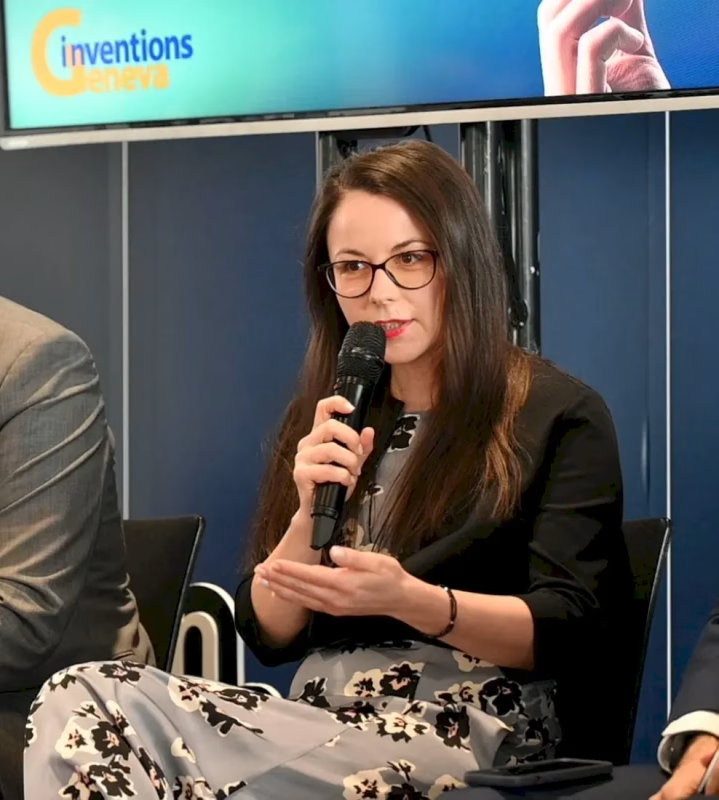
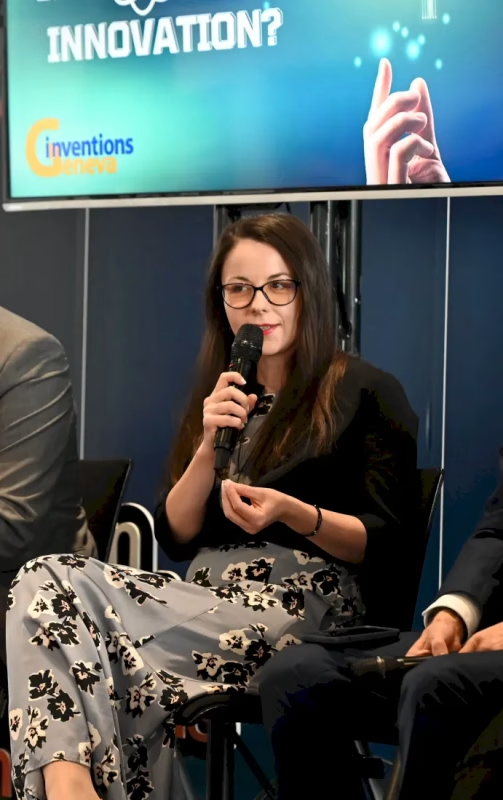
What role does artificial intelligence play in your current operations or future plans?
Before my life as an entrepreneur, I had the privilege to work with Artificial Intelligence long before it was a commodity. I remember some of the use cases that impressed me 10 years ago, when we were able to make operations more efficient or speed up communication between humans and machines. I am a visionary, so I quickly understood that AI is here to stay, and I was quick to adopt Generative AI. For example, now it’s much easier to create not only a persona in a Design Thinking process for a new service or a new product, but you can create 10 personas and test that new service or product easier and faster on the market. Also, you can prototype much faster in a digital format and run tests with it before moving forward to create something at scale.
Today, as I enhance my own abilities to work with AI, I also started to educate myself more on Emotional Intelligence. I think as AI develops more, Emotional Intelligence will become even more critical, and the ability to navigate between the two will be essential. And inspired by what I discovered in my recent learning exploration, I developed a workshop where I uncover the differences between AI and EI in terms of their history and how we can look at our work today with these 2 lenses. What is it from my job today that AI will be able to do in the next 2-5 years? What is it from my job today that I do using EI and what associated skills I should continue to develop to remain relevant on the job market?
With the work I do with Disruptive Humans, I focus not only on technology, but mostly on people. Technology can be a solution, a means to solve a problem. My role is to solve the problems and challenges that other leaders have. I am a strong believer that people give life to technology and it’s important for all of us to use our energy and resources in the most relevant areas for us. This is how we can continue to nurture our creativity, our imagination, our curiosity and our empathy. These are (still!) human attributes.
Can you share a significant challenge you’ve faced in your business and how you overcame it?
Tough question. And I will give a tough answer on this. Probably the biggest challenge I’ve had is that I operate in an industry still dominated by men and I had to learn how to own my place and my niche as a woman. When I was younger, I thought the successful strategy is to act more like a man, think more like a man, talk more like a man. But that turned against me and it really burned me out. It was perhaps the hardest and most painful lesson to learn. To me, losing money wasn’t as painful as losing myself. Trying to be someone I wasn’t became detrimental for me and for my business and it felt like more like a struggle than a passion.
Today, I have a different mindset, and I am still working on my own self-development and self-innovation – how I define it. I’m operating from my own authenticity and it’s good not only for myself but also for the business and the clients I work with.
How do you approach strategic planning and decision-making in your organization?
Having this mindset of innovation, really helped me integrate 2 important characteristics in the way I operate: fail fast and lessons learned. Whatever I try out for the first time, and I want to experiment on, I am looking to fail fast. The faster I fail, the faster I identify the lessons learned and integrate them in my next initiative or project.
I’m always reminding myself to think like a researcher. Researchers don’t focus on what doesn’t work. They assume their hypothesis are wrong. So, when there is a successful experiment, they will focus there, to understand what made it successful and how they can replicate that success.
As for the decision making, my philosophy is to always have a “no” in my pocket, in order to be able to steer the boat and align it with my Life mission and purpose, whenever some wind might drift it away.
What is your approach to leadership and fostering a positive company culture?
I am still learning as a leader. And probably I will learn and develop my leadership style until I die, not until I retire. I don’t plan to retire. I hope to be around and continue to contribute and support future generations as best as I can. And that’s how I see leadership, we are serving a purpose much greater than us with a motivation that never dies.
The first time I learned about company culture—the depth of the topic and the impact it can have on a business and its profitability and productivity it was back in 2020. I was mind blown. It became so important to me that I decided to become a Human Synergistics Consultant and embed culture in everything I did. That’s why, even for Innovation projects and initiatives, I always talk about Innovation Culture and what that means. And for the past 5 years I worked on making the topic of Culture tangible for my clients.
How do you ensure your business remains adaptable and responsive to market changes?
I believe it’s my own responsibility to be an adaptable person first. It’s hard to adapt a business or make disruptive changes if your personality is not like that. So, first, I push myself outside of my comfort zone on a regular basis. This is a great way to train on change, on responding to change and adapting to change, but most importantly on changing the business before being forced to by external context.
I stay in touch with the market by attending relevant networking events, but also by connecting outside of my industry. Duncan Wardle says, “Diversity is Innovation” and I live by that. I keep my mind open, and I have regular checkpoints on what is still relevant versus what is not. Having worked in Global roles, helped me developed a broader view and create connections all over the world. Staying connected with people across all continents helps me stay connected with the different markets.
Can you discuss a recent innovation or project that has been particularly successful for your company?
Let me give you a personal example here. I launched a Social Innovation project one year ago – Pain Patterns. The project is something very close to my heart. The aim is to create awareness about the difference between menstrual pain and menstrual cramps and emphasize that menstrual pain is like any other pain – not normal. Women should have a better way to differentiate between menstrual pain and menstrual cramps. So, I went through an Innovation Process with this idea. I used ChatGPT to brainstorm, to create the logo, I did most of my research with it and with Perplexity. It helped me a lot to uncover studies and research that gave me a better understanding of the current situation and context. In the absence of consolidated statistics, I used ChatGPT to summarize all the numbers and data from different sources and create simple charts for a better visual representation. And today, my opening pitch statement is: Every minute 2 women lose their uterus or their ovaries due to endometriosis or polycystic ovaries syndrome. I was able to reach this shocking reality, after using technology to put all the pieces together and extract this powerful information.
I wanted to start exploring the Social Innovation niche, because it’s very different than Corporate Innovation and it’s a way to empower everyone to become innovative and exercise their innovation capability. With this project, I proved that you could bring your idea to life with very little investment. I invested less than 300$ for this initiative and of course my personal time. The idea evolved radically through four iterations before reaching its current form, which is a Pain Assessment. With this Pain Assessment, anyone can evaluate if they or a family member or a close friend might experience menstrual pain.
What are your long-term goals for your business, and how are you working towards achieving them?
I plan to develop more this segment dedicated to Social Innovation, which will empower more people to go after their dreams and give life to ideas that could bring great positive impact for society and specific communities of people. I am planning to create a Social Innovation Hub here in Geneva, dedicated to this. It’s a very ambitious initiative and I am more motivated than ever because it aligns with my life mission of supporting future generations in a sustainable way.
At the same time, I am continuing my work on promoting technology and Artificial Intelligence integration and adoption, complementing it with Emotional Intelligence aspects. The workshop proved to be very popular among clients, and it has surpassed the requests for my AI integration Toolbox.
And lastly, another area that was requested and it’s starting to become more popular in 2025 is the self-innovation work that I do with some clients, using the Chinese Metaphysics art and some concepts from Innovation Management or even the human-centric Design-Thinking approach.
All these themes align beautifully with my mission of helping people and creating a positive long-lasting impact in their lives. This is what makes me wake up energized every morning and it’s the best feeling in the world.
What advice would you give to emerging entrepreneurs in your industry?
I’m going to give the advice that most of us don’t know we need, and it has become my daily mantra – Every day, show up for yourself!. If you find the right ways to train your brain on how to show up for yourself and develop that self-respect, the rest will come naturally.
And I will add 2 things I mentioned in the previous questions, that are key when you are starting: Fail Fast and Keep Going.
I don’t have any magical recipe, but I do think there is magic in all of us and it’s important to acknowledge that, accept our inner magic and let it shine with authenticity.
About the speaker
A Romanian-born innovator based in Switzerland, she is the founder of Disruptive Humans, blending corporate innovation, generative AI, and ancient Chinese Metaphysics to empower individuals and organizations. With over 20 years of experience in tech and personal development, she leads workshops on innovation, strategic execution, and self-transformation. Her mission: to help people innovate themselves and their environments before change becomes a necessity.
Want to get in touch with Antonia?
- Connect on LinkedIn: https://www.linkedin.com/in/antonia-lomer/
- Send her an email: [email protected]
And you can check out her personal website here: https://antonialomer.com

